Close


Sri Lanka’s export economy has entered a remarkable new chapter. While traditional export giants such as Ceylon Tea and Ceylon Cinnamon continue to strengthen the country’s international reputation, coconut and coconut-based products have now emerged as one of the nation’s most valuable export sectors. According to recently circulated annual export revenue data, Sri Lanka’s coconut-based exports now generate approximately USD 800–865 million annually, making the coconut sector one of the country’s top foreign income contributors.
More importantly, the sector continues to record one of the fastest growth trajectories among Sri Lanka’s major export industries. As global consumers increasingly shift toward natural, organic, plant-based, and health-focused products, Sri Lankan coconut products have gained exceptional demand across international markets.
At the center of this transformation, you can clearly see the contribution of Sri Lanka’s leading coconut oil manufacturers and exporters. Among them, Sena Mills Refineries (SMR) proudly stands as Sri Lanka’s largest coconut oil exporter, while Coco Organic continues to strengthen Sri Lanka’s premium organic coconut oil reputation across global retail shelves.
Today, when you look at Sri Lanka’s export success story, you are also witnessing the growing influence of the coconut industry in reshaping the nation’s economic future.
For decades, Sri Lanka built its export identity mainly through tea and spices. However, the global market has changed rapidly over the last several years. Consumers now actively seek healthier cooking oils, organic ingredients, sustainable food products, and natural wellness solutions. Consequently, coconut-based products have moved from a niche category into a mainstream global demand segment.
According to the Sri Lanka Export Development Board (EDB), coconut kernel products, coconut oil, virgin coconut oil, desiccated coconut, coconut milk, coconut cream, coconut water, coconut flour, and activated carbon have all recorded strong export performance in recent years.
Furthermore, the International Coconut Community (ICC) has repeatedly highlighted growing international demand for coconut-derived food and wellness products due to increasing consumer preference for plant-based and natural alternatives.
As a result, Sri Lanka’s coconut industry has evolved far beyond raw agricultural exports. Today, the country exports value-added coconut solutions to supermarkets, foodservice operators, industrial buyers, wellness brands, and health-conscious consumers worldwide.
Therefore, when Sri Lanka’s coconut sector reached approximately USD 800–865 million in annual export revenue, the achievement reflected much more than strong sales numbers. It reflected the country’s successful transition toward high-value agricultural exports.
Several global consumer trends continue to drive the rapid growth of coconut-based exports.
First, health-conscious consumers increasingly prefer coconut oil over heavily processed cooking oils. Virgin coconut oil, in particular, has gained popularity among consumers who prioritize natural ingredients and minimally processed foods.
Second, vegan and plant-based food industries continue to expand worldwide. Coconut milk, coconut cream, coconut flour, and coconut-based dairy alternatives now appear in thousands of retail products globally.
Third, clean-label product demand has accelerated across Europe, the Middle East, Asia, and North America. Consumers actively check ingredient lists and prefer products with fewer artificial additives.
Additionally, organic food consumption continues to rise globally. According to the latest reports published by the Research Institute of Organic Agriculture (FiBL) and IFOAM – Organics International, the global organic food and beverage market exceeded EUR 136 billion in 2023, while organic farming activities expanded across nearly 99 million hectares worldwide. Furthermore, more than 4.3 million organic producers now operate globally, demonstrating the accelerating international shift toward healthier, cleaner, and environmentally responsible food consumption.
Consequently, Sri Lanka holds a major competitive advantage because the country naturally produces high-quality coconuts under favorable tropical conditions.
When you analyze the growth of Sri Lanka’s coconut export sector, you cannot overlook the contribution made by Sena Mills Refineries (SMR).
For more than six decades, SMR has consistently invested in manufacturing excellence, international expansion, quality assurance, and value-added coconut innovation. As Sri Lanka’s largest coconut oil exporter, the company has played a significant role in introducing Sri Lankan coconut oil to international buyers across multiple continents.
Moreover, SMR has continuously elevated the global perception of Sri Lankan coconut products through large-scale exports, reliable supply capabilities, and internationally compliant production systems.
Unlike smaller operators that focus only on trading activities, SMR has built vertically integrated operational strength. This structure allows the company to maintain greater consistency in quality, supply chain management, manufacturing efficiency, and export reliability.
As international markets became increasingly competitive, SMR strengthened its capabilities further by investing in:
Consequently, international buyers continue to recognize Sri Lankan coconut oil as a trusted and premium-quality product category.
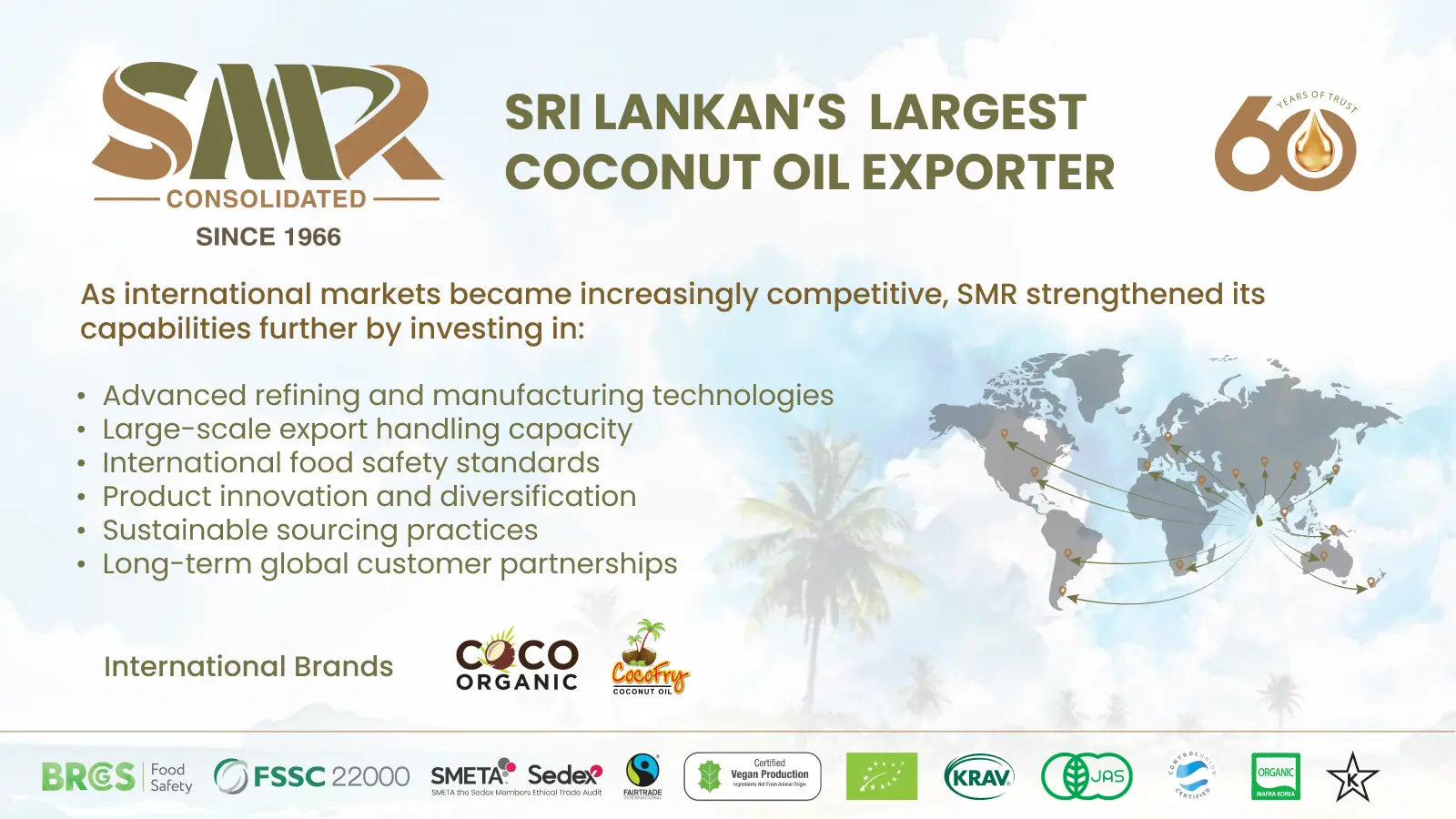
Sri Lanka’s largest coconut oil exporter
While SMR drives large-scale export operations, Coco Organic has successfully strengthened Sri Lanka’s premium retail positioning in global markets.
Today, consumers increasingly seek brands that represent authenticity, purity, transparency, and wellness. Coco Organic directly responds to these expectations through high-quality organic coconut oil offerings designed for modern health-conscious consumers.
Importantly, Coco Organic does not simply sell coconut oil. Instead, the brand communicates a lifestyle centered around wellness, family health, natural living, and trusted quality.
You can already observe this growing international acceptance through the brand’s expanding presence in major retail chains, including Lulu Hypermarket chain, Metro hypermarket chain in Europe, Lotte Department Stores in Korea, Hyundai Department Stores, AK Plaza Department Stores, Shinsagae Department Stores across the South Korea region. Such retail penetration demonstrates the rising consumer trust placed in Sri Lankan coconut products.
Additionally, Coco Organic benefits from several important competitive strengths:
As global retail markets become more quality-driven, these strengths create a significant competitive advantage for Sri Lankan coconut brands.
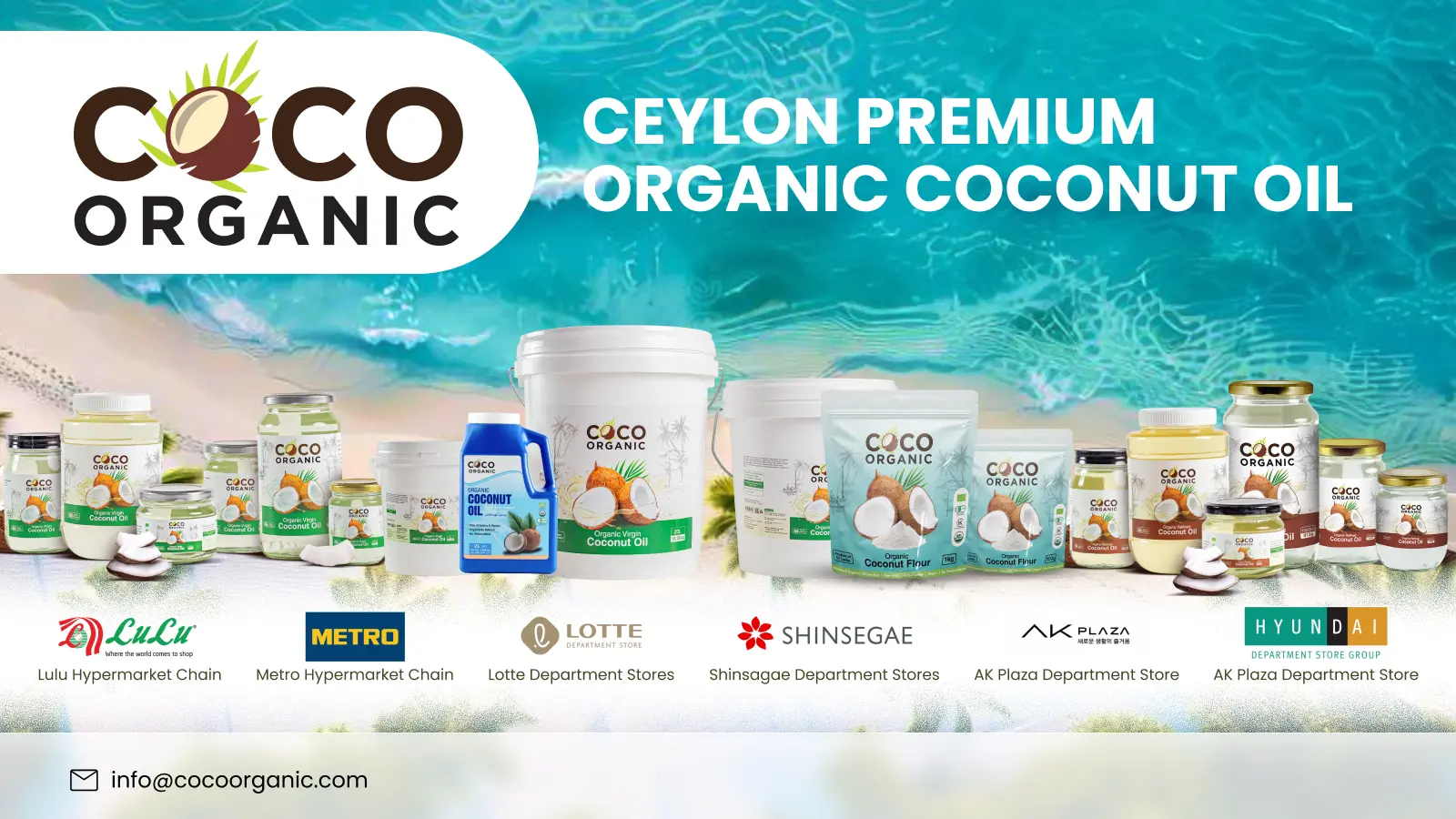
Ceylon Premium Organic Coconut Oil
Sri Lanka possesses several unique advantages that continue to support export growth.
Sri Lanka’s tropical climate creates ideal growing conditions for coconuts. Consequently, Sri Lankan coconuts maintain strong international recognition for quality, aroma, and natural characteristics.
Over the years, Sri Lankan exporters developed sophisticated processing capabilities for coconut oil, virgin coconut oil, desiccated coconut, coconut milk products, and value-added derivatives.
Because global organic demand continues to rise, Sri Lanka’s coconut industry aligns naturally with modern consumer trends.
Sri Lankan exporters now maintain long-standing relationships with international distributors, retailers, and foodservice operators across Asia, Europe, the Middle East, and North America.
Instead of depending solely on raw exports, Sri Lanka increasingly focuses on value-added coconut products. Consequently, the industry generates stronger export earnings and better long-term market positioning.
The growth of coconut exports creates significant economic benefits for Sri Lanka beyond foreign exchange earnings alone.
The industry supports:
Furthermore, stronger coconut export performance helps diversify Sri Lanka’s export economy. Historically, the country depended heavily on tea and apparel exports. However, coconut-based products now provide an additional high-potential revenue stream.
This diversification strengthens national economic resilience and creates broader long-term opportunities.
Although Sri Lanka’s coconut industry already achieved impressive milestones, future opportunities appear even greater.
Global demand for:
continues to increase year after year.
Therefore, Sri Lanka’s coconut sector remains strongly positioned for continued growth.
At the same time, companies like SMR and brands like Coco Organic continue to expand manufacturing capability, export reach, and international brand recognition. This ongoing investment creates stronger global confidence in Sri Lankan coconut products.
Additionally, Sri Lanka’s reputation for authenticity and natural product quality provides an important advantage that many competing markets cannot easily replicate.
The emergence of coconut and coconut-based products as one of Sri Lanka’s leading export revenue contributors represents a proud national achievement.
However, this milestone did not happen overnight. The achievement resulted from decades of dedication by farmers, manufacturers, exporters, brand builders, and industry leaders who continuously believed in the global potential of Sri Lankan coconut products.
Today, when you see Sri Lanka’s coconut industry ranked among the nation’s top export earners, you are witnessing the outcome of long-term vision, innovation, resilience, and international trust.
As Sri Lanka’s largest coconut oil exporter, SMR proudly continues to contribute to this national success story. Meanwhile, Coco Organic continues to elevate Sri Lanka’s premium organic coconut reputation across international retail markets.
Most importantly, this achievement signals something even bigger: Sri Lanka’s coconut industry has not reached its peak yet. Instead, the industry is entering a new era of global expansion, premium positioning, and sustainable long-term growth.
And as the world increasingly chooses healthier, cleaner, and more natural products, Sri Lankan coconut exports stand ready to lead that future.
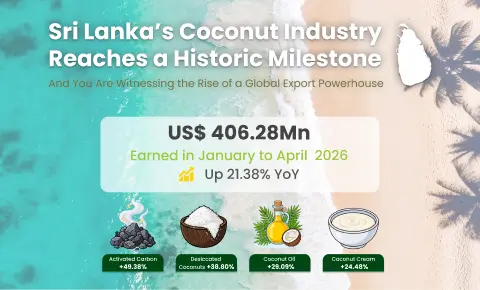
Sri Lanka’s coconut industry has emerged as a major export powerhouse, generating over USD 800 million annually. Driven by global demand, companies like SMR and Coco Organic continue expanding Sri Lanka’s premium coconut presence worldwide.
Read More